Evaluating Blockchain Smart Contracts for Digital Innovation
In the rapidly evolving landscape of digital finance and Web 3.0, the concept of the Blockchain Smart Contract has transitioned from a theoretical novelty to a foundational element of modern technology. For individuals and organizations researching how to secure transactions, manage digital assets, or launch new business models, understanding the practical application of these self-executing agreements is essential. Unlike traditional contracts that rely on intermediaries, smart contracts operate on decentralized networks, offering a unique blend of automation, transparency, and security. This evaluation explores what these contracts are, when they are the right tool for your needs, and the tradeoffs involved in their implementation.
Understanding the Mechanics of Blockchain Smart Contracts
A Blockchain Smart Contract is essentially a computer program stored on a blockchain that automatically executes terms of an agreement when predefined conditions are met. Imagine a vending machine: you insert money (input), select an item, and the machine delivers the product (output) without a human cashier needing to intervene. In the digital realm, this mechanism handles everything from transferring cryptocurrency tokens to verifying ownership of non-fungible tokens (NFTs).
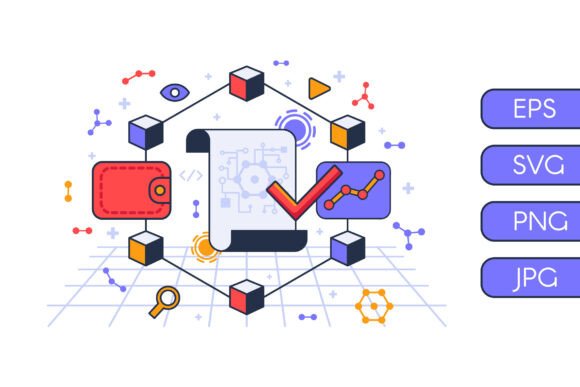
These contracts are immutable once deployed, meaning the code cannot be altered, which ensures that the agreed-upon rules are followed exactly as written. They facilitate interactions between digital wallets, validate data through cryptographic methods, and record transactions on a distributed ledger. This structure eliminates the need for third-party verification, reducing the risk of human error or manipulation. For those visualizing this technology, modern vector illustrations often depict these concepts through interconnected nodes, digital scrolls with code, and check symbols representing validation—symbolizing the seamless flow of trustless transactions.
Why Consider Implementing Smart Contracts?
There are several compelling reasons why researchers, developers, and investors are turning to smart contracts. The primary driver is efficiency. By automating complex processes, businesses can significantly reduce the time and cost associated with legal paperwork, escrow services, and administrative overhead. Whether managing fungible tokens for currency or non-fungible tokens for digital art, the speed of execution is unmatched by traditional systems.
Another critical factor is security and transparency. Because the contract code is visible on the blockchain and executed across multiple nodes, it provides an auditable trail of all actions. This is particularly valuable for financial investment tools and passive income strategies where trust is paramount. Users can verify the logic of a contract before interacting with it, ensuring that funds are handled according to strict protocols. Additionally, for creators looking to start an NFT profitable project, smart contracts offer a reliable way to enforce royalty payments and ownership rights automatically.
Benefits and Tradeoffs: A Balanced View
While the advantages are significant, a balanced evaluation requires acknowledging the limitations. The benefits of using a Blockchain Smart Contract include:
- Automation: Removes manual intervention, reducing delays and operational costs.
- Trustlessness: Parties do not need to trust each other, only the code.
- Immutability: Prevents unauthorized changes to the agreement after deployment.
- Global Accessibility: Operates 24/7 across borders without jurisdictional friction.
However, there are notable tradeoffs to consider. The most significant is the rigidity of the code. If a bug exists in the smart contract or if real-world circumstances change in a way the code did not anticipate, rectifying the situation can be difficult or impossible. Unlike a paper document that can be amended with a signature, a deployed contract generally cannot be edited. Furthermore, the "oracle problem" remains a challenge; smart contracts cannot easily access off-chain data without a trusted intermediary, which can limit their utility in scenarios requiring real-world inputs like weather data or stock prices.
Cost is another consideration. Deploying and executing contracts requires transaction fees (gas), which can fluctuate wildly depending on network congestion. For high-volume, low-value transactions, these costs may outweigh the benefits of automation.
When Smart Contracts Are a Strong Fit
Smart contracts are ideally suited for situations where the terms of an agreement are clear, binary, and do not require subjective interpretation. They excel in the following scenarios:
- Cryptocurrency Exchanges and DeFi: Automated trading pairs, lending protocols, and liquidity pools rely heavily on precise mathematical execution.
- NFT Marketplaces: Managing the minting, selling, and royalty distribution of digital art and collectibles.
- Supply Chain Tracking: Verifying the origin and movement of goods through immutable records.
- Escrow Services: Holding funds until specific deliverables are confirmed, such as software completion or physical shipment.
If your goal is to create a crypto financial investment tool or launch a Web 3.0 e-commerce business where speed and automated enforcement are priorities, a blockchain smart contract is likely the optimal choice. It aligns well with the modern trend of decentralized finance (DeFi) and digital asset management.
When Alternatives May Be Worth Considering
Despite their power, smart contracts are not a universal solution. There are situations where traditional legal frameworks or centralized databases may be more appropriate:
- Complex Legal Disputes: Agreements requiring nuance, intent analysis, or judicial discretion are better handled by traditional lawyers and courts.
- Privacy-Sensitive Data: Since blockchains are public ledgers, storing sensitive personal information directly on-chain is risky. Private databases may be safer for confidential data.
- Frequent Updates: If a business model requires frequent changes to its terms, the immutability of smart contracts becomes a hindrance rather than a feature.
- Low-Value Transactions: If the transaction volume is high but the value per transaction is very low, gas fees may make the process economically unviable.
In these cases, a hybrid approach might be best, using smart contracts for the financial settlement layer while maintaining a traditional system for dispute resolution and data privacy.
Practical Decision-Making Insights
Before integrating a Blockchain Smart Contract into your strategy, conduct a thorough assessment of your specific needs. Ask yourself: Are the terms of my agreement strictly definable in code? Is the cost of automation lower than the current administrative burden? Do I have the technical expertise to audit the code for vulnerabilities?
For those entering the crypto market, starting an NFT project, or developing crypto tech innovation, due diligence is critical. Utilize resources that explain the underlying mechanics, such as detailed vector illustrations that break down the components of a wallet, token, and validation process. These visual aids can help stakeholders understand the flow of data and the points of interaction.
Furthermore, consider the long-term implications. Once a contract is live, it governs the relationship between parties indefinitely unless programmed otherwise. Ensure that your team includes both legal experts familiar with digital assets and skilled developers capable of writing secure, efficient code. The goal should be to leverage the efficiency and security of blockchain technology while mitigating the risks of rigidity and potential exploits.
Ultimately, the decision to adopt blockchain smart contracts depends on balancing the desire for automation and decentralization against the need for flexibility and privacy. By carefully evaluating your objectives and the specific constraints of your project, you can determine whether this technology aligns with your goals for building a robust, future-proof digital infrastructure.